
Inheriting a house in Eugene, Oregon, often comes with unexpected legal and financial complexity. Probate, the court-supervised process for settling a deceased person’s estate, can take several months to over a year in Lane County. During that time, the property may sit vacant, accumulate maintenance costs, and lose value.
Many heirs want to sell quickly but find themselves uncertain about their legal authority to do so. The path forward depends on how the property was titled, whether a will exists, how many beneficiaries are involved, and whether the estate requires full probate or qualifies for a simplified process.
This article explains how probate status affects property sales, outlines options for minimizing delays, and describes what inherited home sales typically look like in the Eugene market.
Can You Sell an Inherited House in Eugene Before Probate Is Finished?
In most cases, yes, but the executor or personal representative must have legal authority before listing or transferring the property. Oregon law requires that someone be formally appointed by the court to act on behalf of the estate before a sale can proceed.
If the property was held in a revocable living trust, probate may not be required at all. The successor trustee named in the trust document can typically sell the property without court involvement. However, if the home was solely in the deceased person’s name and no trust exists, the estate will likely need to go through probate before a valid sale can close.
Some estates qualify for a simplified process known as a small estate affidavit under Oregon Revised Statutes (ORS) 114.505 to 114.560. This may apply when the total estate value falls below the statutory threshold, allowing heirs to transfer property without full probate proceedings.
How Probate Status Affects the Ability to Sell
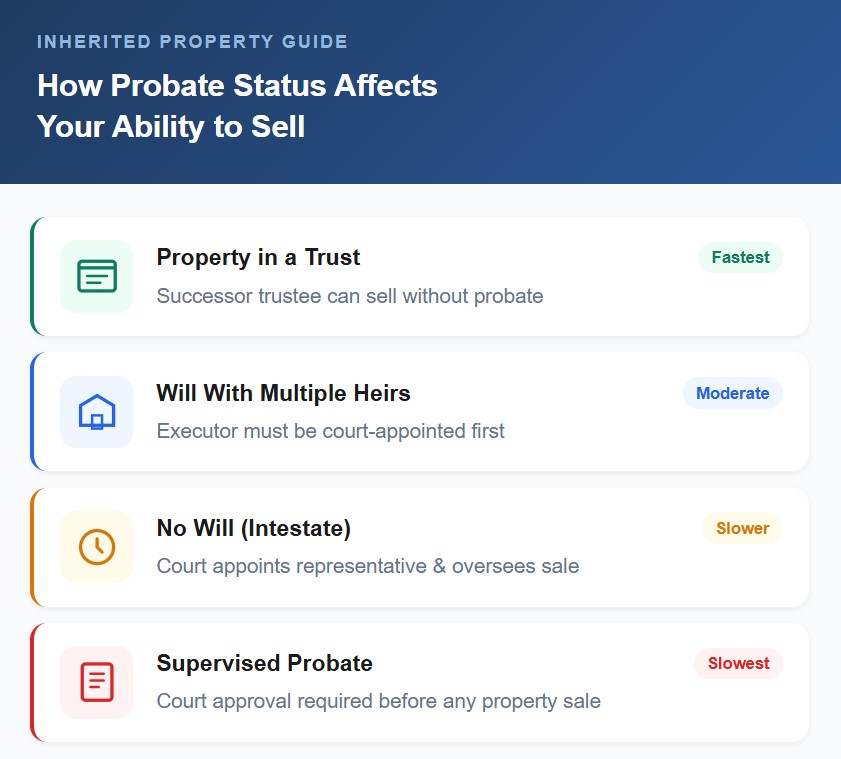
The legal status of the estate directly controls whether, when, and how an inherited property can be sold. Several common scenarios determine the available options.
Property Held in a Trust
When a home is held in a revocable living trust, the successor trustee gains authority to sell the property after the grantor’s death. No probate filing is needed. The trustee can list the property, negotiate with buyers, and sign the deed. This is typically the fastest path to a sale.
Multiple Heirs With a Will
If the deceased left a will naming multiple beneficiaries, the executor named in the will must be formally appointed by Lane County Circuit Court. Once appointed, the executor can sell the property, but all beneficiaries typically need to be notified and may need to consent, depending on the terms of the will.
No Will (Intestate Estate)
When someone dies without a will in Oregon, the estate passes according to state intestacy laws. The court appoints a personal representative to manage the estate. Selling the property requires court approval, and the process generally takes longer because the court must verify rightful heirs and oversee the distribution.
Court Supervision Requirements
In supervised probate, the personal representative must obtain court approval before selling real property. This involves filing a petition, potentially getting an appraisal, and waiting for a court hearing. Unsupervised probate gives the representative more flexibility, but even then, proper documentation and notice to heirs are required.
Executor Authority
An executor or personal representative cannot sell inherited property until they receive Letters Testamentary or Letters of Administration from the court. These documents prove the representative’s legal authority to act on behalf of the estate. Without them, no title company will process the transaction.
Options for Selling While Minimizing Probate Delays
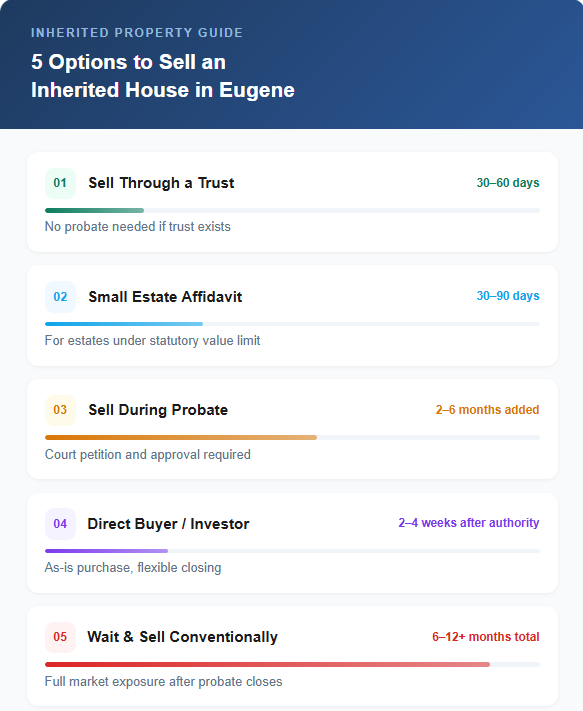
Several strategies can help heirs sell an inherited property more quickly. Each varies in legal complexity, speed, and how much coordination is needed among beneficiaries. The right approach depends on the specific estate circumstances.
Option 1: Sell Through a Trust (If Applicable)
How It Works
If the deceased placed the property in a revocable living trust before passing, the successor trustee can sell the home without probate. The trustee provides a copy of the trust, a death certificate, and a trustee certification to the title company.
Who Must Approve
Only the successor trustee needs to authorize the sale. Beneficiaries named in the trust are typically notified but do not need to sign off on the transaction unless the trust document specifically requires it.
How Long It May Take
A trust-based sale can often close within 30 to 60 days, similar to a conventional real estate transaction. There is no waiting period imposed by the court.
Advantages
- No probate filing required.
- Fastest path to closing.
- Minimal court involvement.
- Lower legal costs compared to probate.
Risks or Limits
- Only works if the property was properly transferred into the trust before death.
- If the trust document is contested, sale may be delayed.
- Trustee must still comply with fiduciary duties to all beneficiaries.
Option 2: Small Estate Affidavit
How It Works
Oregon allows heirs to use a small estate affidavit to claim property without full probate when the total estate value is below the statutory limit. The affidavit is filed with the court, and after a waiting period, heirs can transfer or sell the property.
Who Must Approve
All heirs entitled to the property under the will or intestacy law must agree and sign the affidavit. If any heir objects or is unavailable, this option may not be viable.
How Long It May Take
The process typically takes 30 to 90 days, depending on how quickly heirs coordinate and whether any issues arise with the estate’s value or creditor claims.
Advantages
- Avoids the full probate process.
- Lower cost than formal probate.
- Simpler paperwork and fewer court appearances.
Risks or Limits
- Only available for estates under the statutory value threshold.
- Requires agreement from all heirs.
- May not be suitable if there are significant debts or creditor claims.
- Real property transfer still requires proper recording with the county.
Option 3: Sell During Probate With Court Approval
How It Works
In a standard probate proceeding, the personal representative can petition the court for permission to sell the property. The court reviews the proposed sale terms, and if approved, the representative can proceed with the transaction.
Who Must Approve
The personal representative petitions the court, and all interested parties (heirs, beneficiaries, creditors) receive notice. In supervised probate, the judge must approve the sale. In unsupervised probate, the representative may have broader authority depending on the will’s terms.
How Long It May Take
Selling during probate typically adds 2 to 6 months beyond what a normal sale would take. Court scheduling, notice periods, and potential objections all contribute to the timeline.
Advantages
- Allows the sale to proceed without waiting for probate to fully close.
- Court approval provides legal certainty for the buyer.
- Can help the estate cover ongoing property costs.
Risks or Limits
- Requires court petition and hearing, adding time and legal costs.
- Heirs or creditors may object to the sale price or terms.
- Buyer must be willing to wait for court approval.
- The court may require a property appraisal before approving the sale.
Option 4: Sell to a Direct Buyer or Investor
How It Works
Some buyers, particularly local investors and direct home-buying companies, specialize in purchasing inherited properties. These buyers are often familiar with the probate process and may be willing to work around the legal timeline, closing once the representative has authority.
Who Must Approve
The executor or personal representative must have legal authority to sell. If the estate is in probate, court approval may still be required. All heirs should be notified of the proposed sale.
How Long It May Take
Direct buyers can often close within 2 to 4 weeks after the representative secures authority. However, the total timeline depends on how quickly the estate clears probate or trust requirements.
Advantages
- Buyer typically purchases the property as-is, reducing preparation costs.
- No need for repairs, staging, or showings.
- Flexible closing timeline that can align with probate schedules.
- Buyer may have experience navigating estate-related paperwork.
Risks or Limits
- Sale price may be below full market value.
- Quality and reliability of buyers vary significantly.
- Heirs should compare multiple offers before accepting.
- Legal authority must still be established before closing.
Option 5: Wait for Probate to Close, Then Sell Conventionally
How It Works
Some heirs choose to wait until probate is fully resolved and the property title transfers to the beneficiaries. Once the heirs hold clear title, they can sell the property through a traditional real estate listing with a real estate agent.
Who Must Approve
After probate closes, the heirs who receive the property must all agree to sell. If multiple heirs co-own the property, all must sign the listing agreement and the deed.
How Long It May Take
Probate in Oregon generally takes 6 to 12 months or longer. After that, listing and selling the property adds another 30 to 90 days depending on market conditions in Eugene.
Advantages
- Clean title with no probate complications for the buyer.
- Full exposure to the open market, potentially achieving the highest sale price.
- Standard real estate transaction with established protections.
Risks or Limits
- Longest total timeline of all options.
- Property sits vacant during probate, accumulating costs.
- Maintenance, insurance, property taxes, and potential vandalism risks.
- Market conditions may change during the waiting period.
How Inherited Home Sales Typically Unfold in Eugene
The Eugene real estate market has its own characteristics that affect inherited property sales. Buyer expectations, property conditions, and local court timelines all play a role in how these transactions develop.
Inherited homes in Eugene are frequently older properties that may need repairs or updates. Buyers in this market often factor in renovation costs when making offers, which can result in lower initial bids compared to move-in-ready homes. Properties in neighborhoods near the University of Oregon or in established areas like South Eugene or the Whiteaker neighborhood may attract more interest, but condition still matters.
Lane County Circuit Court handles probate proceedings for Eugene-area estates. Court scheduling and processing times vary, and heirs should plan for potential delays, especially during periods of high caseload. Working with a local probate attorney who understands Lane County procedures can help avoid unnecessary holdups.
Vacant inherited homes tend to attract attention from investors and direct buyers who are comfortable purchasing as-is properties. This can be beneficial for heirs who want to sell quickly, but it also means carefully evaluating offers to ensure fair pricing.
Coordination among out-of-town heirs is a common challenge in Eugene inherited property sales. When beneficiaries live in different states, aligning on decisions about pricing, repairs, and timing can add weeks or months to the process.
The Right Path Depends on the Estate and the Heirs
No single approach works for every inherited property situation. The best path forward depends on several factors that are unique to each estate.
Legal authority is the foundation of any inherited property sale. Whether authority comes from a trust document, court-issued letters, or a small estate affidavit, the representative must have clear legal standing before any transaction can proceed. Title companies and buyers both require proof of authority before closing.
Title clarity is equally important. If there are liens, unpaid taxes, or disputes about ownership, these must be resolved before a sale can close. A preliminary title search early in the process can identify potential issues and prevent delays later.
Agreement among beneficiaries often determines the pace of the sale. When all heirs agree on the decision to sell, the price range, and the method, the process moves significantly faster. Disagreements can lead to court intervention, additional legal costs, and extended timelines.
Heirs should consult with a probate attorney and, if appropriate, a real estate professional familiar with estate sales before committing to a specific approach. Understanding the legal requirements and market realities upfront helps avoid costly mistakes.
Example of Buyers Who Work With Inherited Properties
Some local direct buyers in Eugene specialize in purchasing inherited homes. One example is orhomebuyers.com, a direct home-buying service that has worked with estate representatives on inherited property transactions. Companies like this typically purchase homes as-is and may offer flexible closing timelines that align with probate schedules.
This is one option among several. Heirs should always compare multiple offers, consult with their probate attorney, and evaluate whether a direct sale, traditional listing, or other approach best fits their situation and financial goals.
Comparison of Inherited Property Sale Options
| Option | Legal Complexity | Speed | Coordination Effort | Best For |
| Sell Through Trust | Low | Fast (30–60 days) | Low | Estates with existing trust |
| Small Estate Affidavit | Low to moderate | Moderate (30–90 days) | Moderate | Small estates under statutory limit |
| Sell During Probate | Moderate to high | Slow (2–6 months added) | Moderate to high | Estates needing to cover costs during probate |
| Sell to Direct Buyer | Moderate | Fast once authority is established | Low to moderate | As-is properties, heirs seeking speed |
| Wait and Sell Conventionally | Low (post-probate) | Slowest (6–12+ months total) | High | Heirs wanting maximum market price |
Frequently Asked Questions
Can heirs sell an inherited house if one heir disagrees?
Not easily. In Oregon, all co-owners generally must agree to sell a property. If one heir refuses, the other heirs may need to file a partition action in court, which forces a sale or physical division of the property. Partition actions add legal costs and time. Mediation between heirs is often a more practical first step before pursuing court action.
What happens if the mortgage on an inherited house is unpaid?
The mortgage does not disappear when the owner dies. The estate is responsible for continuing payments, and the lender can initiate foreclosure if payments stop. Federal law (the Garn-St. Germain Act) generally allows heirs to assume the existing mortgage without triggering a due-on-sale clause. Heirs should contact the lender promptly to discuss options, including loan assumption, refinancing, or selling the property to pay off the balance.
Do all heirs need to sign when selling an inherited house?
It depends on the stage of the process. During probate, the executor or personal representative signs on behalf of the estate. After probate closes and title transfers to multiple heirs, all heirs who hold title must sign the deed and closing documents. If any heir is unavailable or uncooperative, the sale cannot proceed without legal intervention.
Can a buyer help with estate paperwork when purchasing an inherited home?
Some buyers, particularly direct buyers experienced with estate transactions, can coordinate with the estate representative and title company to streamline the closing process. However, the buyer cannot provide legal advice or substitute for an attorney. Heirs should always rely on their own probate attorney for legal guidance, even when working with an experienced buyer.
What happens if probate takes many months or longer?
Extended probate is common, particularly when estates involve disputes, debts, or complex assets. During this period, the property must be maintained, insured, and secured. Property taxes continue to accrue. The personal representative can petition the court to sell the property during probate to prevent further financial loss to the estate, but court approval adds its own timeline.
Does Oregon require an appraisal before selling inherited property?
Oregon does not universally require an appraisal, but the court may request one during supervised probate to verify that the sale price is reasonable. Even outside of court requirements, obtaining an independent appraisal can protect the personal representative from claims by heirs that the property was sold below market value.
Are there tax implications when selling an inherited house in Eugene?
Inherited property generally receives a stepped-up cost basis equal to the fair market value at the date of death. This means heirs typically owe capital gains tax only on appreciation that occurs after they inherit the property, not on the full sale price. Oregon also has its own capital gains tax rules. Heirs should consult a tax professional to understand their specific obligations.

Hi, I’m Bob Bash, founder of OR Home Buyers, serving the Oregon community since 2017. We provide full-service real estate solutions, specializing in cash purchases for both residential and commercial properties. I started this business to help our community navigate difficult real estate situations with professionalism, ethics, and compassion.
My goal is simple: to make every client feel relieved and happy when their real estate challenges are resolved. Helping people find solutions and peace of mind is what drives me every day.