Vacant houses cost money every month they sit unsold. Owners continue to pay property taxes, insurance premiums, utility minimums, and maintenance expenses even when no one lives in the home. In Eugene, where weather conditions can accelerate wear on unoccupied properties, the financial burden of vacancy grows over time.
Beyond ongoing costs, vacant homes face elevated risks. These include vandalism, undetected water damage, pest infestations, and insurance complications. The longer a home remains empty, the more likely it is that these issues will reduce its market value or create unexpected repair obligations.
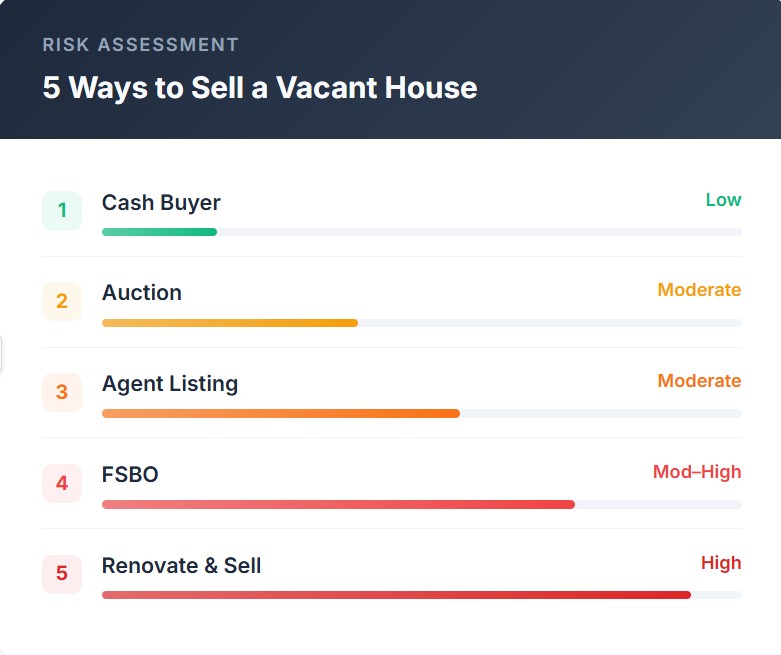
This article ranks five common methods for selling a vacant house in Eugene from lowest risk to highest risk. Each method is evaluated based on financial uncertainty, time exposure, maintenance burden, and likelihood of reaching a successful closing.
What Is Usually the Safest Way to Sell a Vacant House in Eugene?
In most cases, selling to a direct cash buyer carries the lowest overall risk for owners of vacant properties. Cash sales typically close faster, involve fewer contingencies, and do not require the seller to invest in repairs or staging. This reduces both the financial exposure and the time the property remains vacant.
However, no single method is universally best. The right approach depends on the property’s condition, the owner’s financial goals, and how much time and effort the owner is willing to invest. A home in good condition may net significantly more through a traditional listing, while a property needing major repairs may be better suited for a direct sale or auction.
Ranked Options From Lowest Risk to Highest Risk
The ranking below evaluates each method based on four factors: financial uncertainty (how predictable the final sale price is), time exposure (how long the home remains on the market), maintenance burden (how much upkeep the owner must handle during the sale), and likelihood of closing (how often transactions fall through).
Method 1: Sell Directly to a Cash Buyer
How the Sale Process Works
Direct cash buyers purchase properties without requiring bank financing. The process usually begins with the buyer evaluating the property, followed by a written offer within a few days. If the seller accepts, the transaction typically closes within one to three weeks. Most cash buyers purchase homes in as-is condition.
Typical Costs Involved
Sellers generally avoid real estate agent commissions, staging costs, and repair expenses. Closing costs still apply, though some cash buyers cover a portion of these. The primary trade-off is that cash offers are typically below full market value, reflecting the buyer’s assumption of repair costs and the speed of the transaction.
Risks Owners Should Consider
The main risk is accepting a lower sale price than what the open market might produce. Sellers should also verify that the buyer has proof of funds and a track record of closing. Not all cash buyer companies operate the same way, so comparing multiple offers is advisable.
Situations Where This Option Makes Sense
- The property needs significant repairs that the owner cannot or does not want to fund.
- The owner lives out of state and cannot manage a prolonged sales process.
- The home has been vacant for an extended period and carrying costs are accumulating.
- The owner needs to close quickly due to financial, legal, or personal circumstances.
Method 2: Sell at Auction
How the Sale Process Works
Auction sales set a defined date for bidding, creating urgency among buyers. The seller works with an auction company to set reserve prices, market the property, and manage the bidding process. Auctions can be conducted in person or online. Once bidding closes, the highest qualifying bid wins, and closing typically occurs within 30 to 45 days.
Typical Costs Involved
Auction companies typically charge a seller’s premium, a buyer’s premium, or both. These fees can range from 5% to 10% of the sale price. Marketing costs may also be the seller’s responsibility. Some auction companies charge flat fees instead. Traditional closing costs still apply.
Risks Owners Should Consider
The final sale price is unpredictable. A property may attract strong bidding competition, or it may sell below expectations if buyer interest is limited. If the reserve price is not met, the property may not sell at all, leaving the owner back at the starting point with additional marketing costs spent.
Situations Where This Option Makes Sense
- The owner wants a defined timeline with a firm closing date.
- The property is unique or has features that could generate competitive bidding.
- The owner has already tried a traditional listing without success.
- The home is part of an estate and beneficiaries need resolution on a fixed schedule.
Method 3: List With a Real Estate Agent (Traditional Sale)
How the Sale Process Works
A licensed real estate agent lists the property on the Multiple Listing Service (MLS) and markets it to the general buying public. The agent handles showings, negotiations, and transaction coordination. In Eugene, homes in good condition typically receive offers within a few weeks during active market seasons, though vacant or distressed properties may take longer.
Typical Costs Involved
Seller-paid agent commissions have traditionally ranged from 5% to 6% of the sale price, though commission structures vary and may be negotiable. Sellers may also invest in cleaning, staging, minor repairs, landscaping, and professional photography to prepare the property for market. Ongoing holding costs continue throughout the listing period.
Risks Owners Should Consider
Vacant homes listed traditionally face buyer-financed contingencies, including appraisal and inspection requirements. If the appraisal comes in low or the inspection reveals significant issues, buyers may renegotiate or withdraw. The sale timeline is uncertain, and vacant homes may sit on the market longer than occupied ones, increasing both carrying costs and exposure to property damage.
Situations Where This Option Makes Sense
- The home is in good to excellent condition and can show well without significant investment.
- The owner’s primary goal is to maximize the final sale price.
- The local market is active and favoring sellers.
- The owner has the financial capacity to cover holding costs during the listing period.
Method 4: Sell For Sale By Owner (FSBO)
How the Sale Process Works
In a For Sale By Owner transaction, the homeowner manages the entire sale without a listing agent. This includes pricing the property, marketing it, scheduling and conducting showings, negotiating offers, and coordinating the closing process. FSBO sellers may still pay a commission to the buyer’s agent if one is involved.
Typical Costs Involved
FSBO sellers avoid the listing agent’s commission, which can save several thousand dollars. However, they may still pay a buyer’s agent commission. Marketing expenses, legal review fees, and any necessary property preparation costs are the seller’s responsibility. Some FSBO sellers also pay for flat-fee MLS listing services to gain broader exposure.
Risks Owners Should Consider
FSBO sales carry higher execution risk because the seller handles pricing, legal compliance, and negotiations without professional representation. Mispricing the property can result in extended market time or leaving equity on the table. Managing showings for a vacant home adds security considerations. FSBO properties also statistically sell for less on average than agent-listed homes, according to data published by the National Association of Realtors.
Situations Where This Option Makes Sense
- The owner has experience in real estate transactions.
- The property is in a desirable location and likely to attract strong buyer interest without heavy marketing.
- The owner wants to save on listing commissions and is willing to invest personal time.
- The owner already has a potential buyer, such as a neighbor or family member.
Method 5: Renovate, Then List on the Open Market
How the Sale Process Works
This approach involves investing in repairs and upgrades before listing the property for sale. The owner contracts work to address structural, cosmetic, or functional issues, then lists the improved home through a real estate agent or FSBO. The goal is to maximize the sale price by presenting a move-in-ready property.
Typical Costs Involved
Renovation costs vary widely based on the scope of work. Minor cosmetic updates may cost a few thousand dollars, while major renovations involving roofing, plumbing, or structural work can reach tens of thousands. In addition to renovation expenses, the owner continues to pay holding costs throughout the renovation and subsequent listing period. Agent commissions apply if the home is listed through a broker.
Risks Owners Should Consider
This method carries the highest financial risk because the owner invests capital before knowing the final sale price. Renovation projects frequently exceed initial budgets and timelines. In a shifting market, the improved property may not appraise at the expected value, reducing the return on investment. Contractors may be difficult to schedule, particularly during busy seasons in Eugene, which can extend the vacancy period further.
Situations Where This Option Makes Sense
- The property has strong location value but is in poor condition that suppresses its price.
- The owner has available capital and a realistic renovation budget.
- The local market rewards updated, move-in-ready homes with premium pricing.
- The owner has reliable contractor relationships and can oversee the project.
Why Vacant Houses Can Be Harder to Sell in Eugene
Vacant properties present distinct challenges in the Eugene real estate market. Understanding these factors helps owners anticipate potential obstacles and choose an appropriate sales strategy.
Insurance complications. Many standard homeowner insurance policies do not cover properties that have been vacant beyond a certain period, often 30 to 60 days. Owners may need to purchase a separate vacant property insurance policy, which typically costs more and provides narrower coverage. A lapse in coverage creates significant financial exposure.
Security concerns. Vacant homes are more susceptible to break-ins, squatting, vandalism, and theft of fixtures or copper wiring. In Eugene, properties that appear unoccupied may attract unwanted attention, particularly if the yard becomes overgrown or mail accumulates visibly.
Buyer expectations. Buyers and their agents often view vacant homes with heightened scrutiny. The absence of furniture can make rooms appear smaller and imperfections more noticeable. Buyers may also assume that vacancy signals distress, which can lead to lower initial offers.
Repair visibility. Without regular occupants, issues such as slow leaks, pest infestations, mold growth, and HVAC failures may go undetected for weeks or months. By the time these problems are discovered during an inspection, repair costs may have escalated significantly.
Seasonal demand. Eugene’s real estate market generally sees stronger buyer activity in spring and summer. Listing a vacant home during the slower fall or winter months may result in longer time on market. Properties sitting through multiple seasons without selling can develop a stigma among buyers and agents.
The Best Solution Depends on the Owner’s Priorities
There is no single correct way to sell a vacant house. The right method depends on a combination of factors that are specific to each owner’s situation.
Speed. Owners who need to close quickly will generally find direct cash sales or auctions to be the fastest options. Traditional listings and renovations extend the timeline significantly.
Convenience. Sellers who want minimal involvement typically benefit from cash buyers or full-service real estate agents. FSBO sales and renovation projects demand substantial time and hands-on management.
Equity recovery. Owners who prioritize getting the highest possible price may choose a traditional listing or a renovate-then-sell approach. These methods typically yield higher gross sale prices but involve greater costs and longer timelines.
Property condition. The current state of the home is often the most decisive factor. A well-maintained vacant home has different options than one with deferred maintenance, structural issues, or code violations. Properties in poor condition may not qualify for buyer financing, effectively narrowing the sales options.
Most sellers benefit from evaluating at least two or three options before committing to a strategy. Getting a cash offer, an agent’s comparative market analysis, and a renovation estimate provides a practical basis for comparison.
Example of Companies That Purchase Vacant Homes Directly
Several companies operate in the Eugene area that purchase vacant homes directly from owners. These businesses typically make offers within a few days and close on flexible timelines. One example is orhomebuyers.com, a locally focused direct buyer that purchases properties in as-is condition without requiring the seller to make repairs, stage the home, or pay agent commissions.
Direct buyer companies are one of several pathways available to vacant homeowners. As with any transaction, sellers should compare offers, verify the buyer’s credentials, and consult with a real estate attorney or advisor before signing a purchase agreement.
Comparison Table: Selling Methods at a Glance
| Method | Risk Level | Cost Exposure | Effort Required | Best For |
| Direct Cash Buyer | Low | Low | Low | Fast closings, as-is sales, out-of-state owners |
| Auction | Moderate | Moderate | Low to Moderate | Defined timelines, estate sales, unique properties |
| Traditional Agent Listing | Moderate | Moderate to High | Moderate | Maximizing sale price, market-ready homes |
| FSBO | Moderate to High | Low to Moderate | High | Experienced sellers, commission savings |
| Renovate Then Sell | High | High | High | Properties with strong location value, available capital |
Frequently Asked Questions
How fast can I sell a vacant house in Eugene?
Direct cash buyers can typically close within one to three weeks. Auction sales usually close within 30 to 45 days. Traditional listings vary widely depending on market conditions and property condition, but sellers should generally expect at least 30 to 90 days from listing to closing. Properties needing renovation before listing can take several months or longer.
Do I need to make repairs before selling a vacant home?
Not necessarily. Cash buyers and some auction companies purchase homes in as-is condition. However, if you list with an agent, buyers who use mortgage financing will typically require the property to meet certain condition standards. The lender’s appraiser may flag issues that must be addressed before financing is approved.
Will I get less money selling to a cash buyer?
Generally, cash offers are lower than what the open market might produce for a comparable property in good condition. However, cash sales eliminate agent commissions, repair costs, staging expenses, and extended holding costs. The net proceeds after all expenses should be the primary point of comparison, not the headline sale price alone.
What happens to my homeowner’s insurance if the house is vacant?
Most standard homeowner insurance policies include a vacancy clause that limits or excludes coverage after the home has been unoccupied for a set period, typically 30 to 60 days. Owners should contact their insurance provider to understand their specific policy terms and may need to purchase a separate vacant property insurance policy to maintain coverage.
Can I sell a vacant house in Eugene during the winter?
Yes, vacant houses can be sold year-round. However, buyer activity in Eugene tends to be stronger in spring and summer. Winter listings may take longer to attract offers, and the home may need additional weatherization and maintenance attention to prevent cold-weather damage during the listing period.
Should I stage a vacant house before listing it?
Staging can help buyers visualize the space and may lead to faster offers at higher prices. However, staging a vacant home requires additional investment and ongoing coordination. Virtual staging is a lower-cost alternative that digitally furnishes listing photos without placing physical furniture in the home.
How do I choose between these five methods?
Start by clarifying your priorities: speed, price, convenience, or minimal risk. Then assess the property’s current condition and your willingness to invest time and money. Getting estimates or offers from multiple sources, such as a cash buyer offer, an agent’s market analysis, and a contractor’s renovation quote, provides a practical basis for making an informed decision.

Hi, I’m Bob Bash, founder of OR Home Buyers, serving the Oregon community since 2017. We provide full-service real estate solutions, specializing in cash purchases for both residential and commercial properties. I started this business to help our community navigate difficult real estate situations with professionalism, ethics, and compassion.
My goal is simple: to make every client feel relieved and happy when their real estate challenges are resolved. Helping people find solutions and peace of mind is what drives me every day.