
A quitclaim deed in is a legal document that transfers one person’s ownership interest in a property to another person, without making any guarantees about whether the title is clear. Unlike a warranty deed, a quitclaim deed only transfers whatever interest the grantor may hold at the time of signing. It is commonly used in Oregon for family transfers, divorce settlements, and estate planning.
How a Quitclaim Deed Works in Oregon
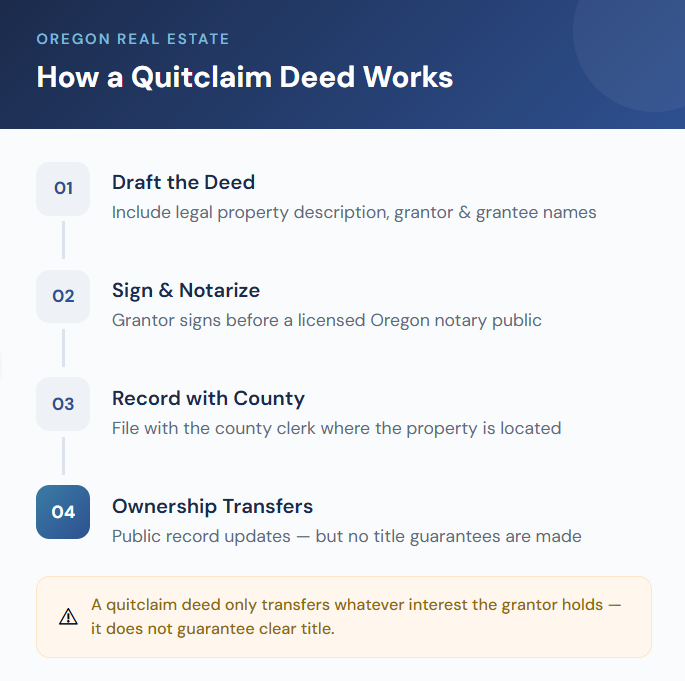
A quitclaim deed transfers whatever ownership interest the person signing (called the grantor) currently has in a property. If the grantor holds full ownership, the entire interest transfers. If the grantor holds no interest at all, nothing transfers — and the recipient has no legal recourse.
This type of deed does not guarantee clear title. It does not confirm that the property is free of liens, encumbrances, or competing ownership claims. The recipient accepts the property “as-is” from a title perspective.
In Oregon, a quitclaim deed must meet specific legal requirements to be valid:
- The deed must be in writing and include a legal description of the property.
- It must be signed by the grantor.
- The grantor’s signature must be notarized.
- The deed must be recorded with the county clerk’s office in the county where the property is located.
Until the deed is recorded, it may not be enforceable against third parties. Recording creates a public record of the ownership change and protects the new owner’s interest.
When Is a Quitclaim Deed Commonly Used?
In Oregon, quitclaim deeds are most often used in situations where the parties involved already know and trust each other. They are not typically used in arms-length real estate transactions between strangers.
Common uses include:
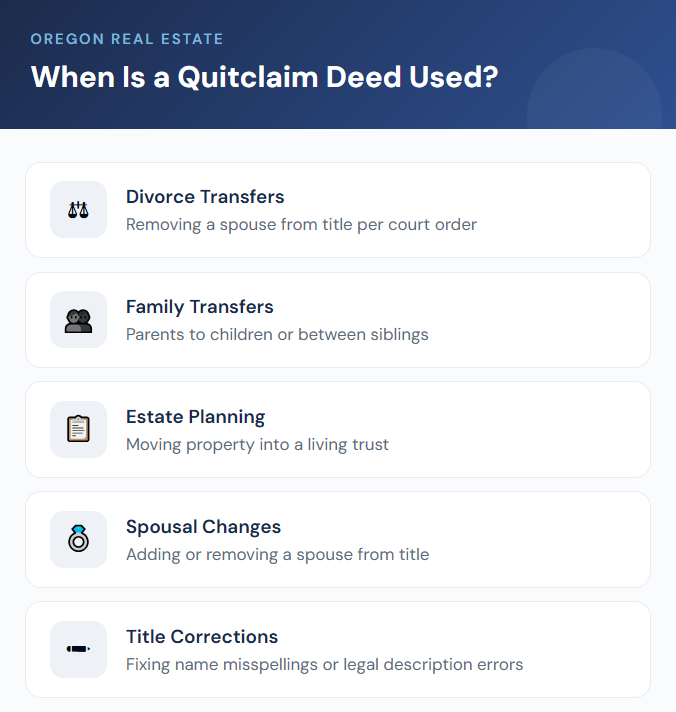
- Divorce property transfers. When a court orders one spouse to transfer their share of a jointly owned property, a quitclaim deed is the standard method in Oregon.
- Adding or removing a spouse from title. After marriage or during estate planning, couples may use a quitclaim deed to adjust how ownership is held.
- Transferring property between family members. Parents transferring a home to an adult child, or siblings dividing inherited property, often use quitclaim deeds.
- Estate planning. Transferring property into or out of a living trust frequently involves a quitclaim deed. For properties that may otherwise go through the court process, Oregon homeowners sometimes use quitclaim deeds as part of a broader probate avoidance strategy. Related topics like what probate property means and whether property can be transferred without probate are worth reviewing when considering this approach.
- Correcting title errors. If a name is misspelled or a legal description contains a minor error, a quitclaim deed can be used to correct the public record.
Risks of Using a Quitclaim Deed
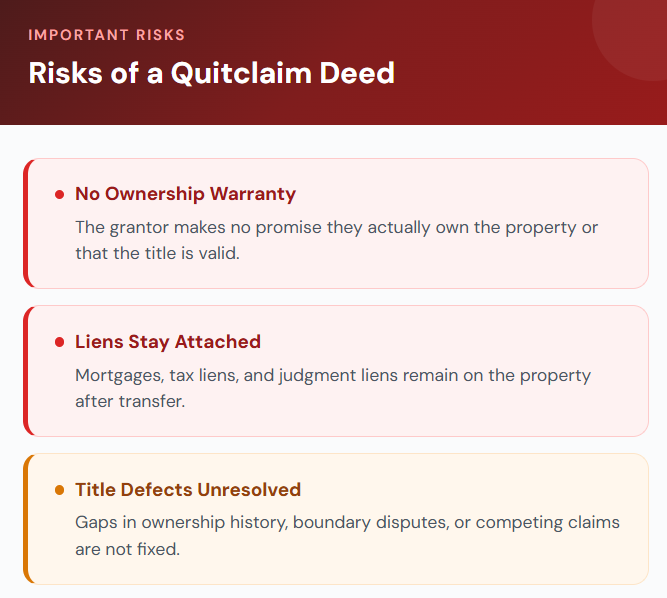
A quitclaim deed offers no warranty of ownership. The grantor makes no promises that they actually own the property, that the title is clear, or that no one else has a valid claim. This is the most important distinction between a quitclaim deed and a warranty deed.
Existing liens remain attached to the property. A quitclaim deed does not remove mortgages, tax liens, judgment liens, or mechanic’s liens. If the property has outstanding debts recorded against it, those obligations transfer with the property. Understanding the types of liens that affect a home sale is essential before using a quitclaim deed. Homeowners dealing with existing liens should also review how to remove liens before selling and the legal steps involved in selling a house with liens.
Title defects are not resolved automatically. If there are gaps in the ownership chain, unresolved claims, or boundary disputes, a quitclaim deed does not fix these issues. The recipient inherits whatever problems exist. For properties with mortgage or judgment liens, additional steps are typically required to resolve those encumbrances. Oregon homeowners can also explore whether it is possible to sell a house with liens in Oregon before pursuing a transfer.
Can You Sell a House in Oregon After a Quitclaim Deed?
Yes, a property received through a quitclaim deed can be sold in Oregon. However, the seller must be able to demonstrate clear title before a buyer or title company will proceed with closing.
A title search is typically required to verify the full ownership history of the property. Title companies review public records to confirm that the current owner has a valid, marketable interest and that no unresolved liens or claims exist.
If the title search reveals outstanding liens, boundary disputes, or gaps in the chain of title, those issues must be resolved before the sale can close. In some cases, obtaining a quiet title action through the court may be necessary.
Homeowners in Oregon who received property through a quitclaim deed and are considering a sale can review their options for selling a house in Oregon.
Oregon Recording Requirements
For a quitclaim deed to be legally effective against third parties in Oregon, it must be properly recorded. Oregon has specific requirements for this process.
- Notarization. The grantor’s signature must be acknowledged before a licensed notary public. Without notarization, the county will not accept the deed for recording.
- County filing. The deed must be filed with the county clerk’s office in the county where the property is physically located. Oregon has 36 counties, and each maintains its own property records.
- Recording fees. Fees vary by county but typically range from $50 to $120 for standard documents. Additional pages or special handling may increase the cost.
- Public record. Once recorded, the deed becomes part of the public record. This officially updates the ownership information and provides legal notice to all parties.
Processing times vary depending on the county. Some Oregon counties process recordings within a few business days, while others may take one to two weeks.
Bottom Line
A quitclaim deed in Oregon transfers whatever ownership interest a person holds in a property — without any guarantees about the quality of that title. It is a simple, commonly used legal tool, but it carries real limitations.
Quitclaim deeds are appropriate for family transfers, divorce settlements, estate planning, and title corrections. They are not recommended for standard real estate purchases between unrelated parties.
A quitclaim deed does not remove mortgages, liens, or other debts attached to the property. Anyone receiving property through a quitclaim deed should consider a title search to understand exactly what they are acquiring.
Frequently Asked Questions
Does a quitclaim deed remove a mortgage in Oregon?
No. A quitclaim deed transfers ownership interest but does not affect the mortgage. The original borrower remains responsible for the loan unless the lender agrees to a release or the mortgage is refinanced.
Is a quitclaim deed legally binding in Oregon?
Yes. A properly signed, notarized, and recorded quitclaim deed is legally binding in Oregon. However, it only transfers whatever interest the grantor actually holds at the time of signing.
Can a quitclaim deed be reversed in Oregon?
Generally, a quitclaim deed cannot be reversed once it is signed, notarized, and recorded — unless both parties agree to execute a new deed transferring the interest back. Fraud or duress may provide legal grounds to challenge the deed in court.
Does a quitclaim deed avoid probate in Oregon?
A quitclaim deed executed during the owner’s lifetime transfers the property immediately, which means it would not pass through probate. However, a quitclaim deed cannot be used after someone has died. Properties that were not transferred before death may need to go through the probate process.
How long does it take to record a quitclaim deed in Oregon?
Most Oregon counties process deed recordings within a few business days to two weeks. The deed is legally effective once delivered to the grantee, but recording provides public notice and protection against third-party claims.

Hi, I’m Bob Bash, founder of OR Home Buyers, serving the Oregon community since 2017. We provide full-service real estate solutions, specializing in cash purchases for both residential and commercial properties. I started this business to help our community navigate difficult real estate situations with professionalism, ethics, and compassion.
My goal is simple: to make every client feel relieved and happy when their real estate challenges are resolved. Helping people find solutions and peace of mind is what drives me every day.