

A title search is a detailed review of public property records used to verify legal ownership and uncover any liens, claims, or encumbrances attached to a property. In Oregon, title searches are typically conducted by a licensed title company before a real estate transaction closes. The purpose is to confirm that the seller has a clear legal right to transfer ownership and that no unresolved financial or legal issues could affect the sale.
A Deeper Look at How Title Searches Work
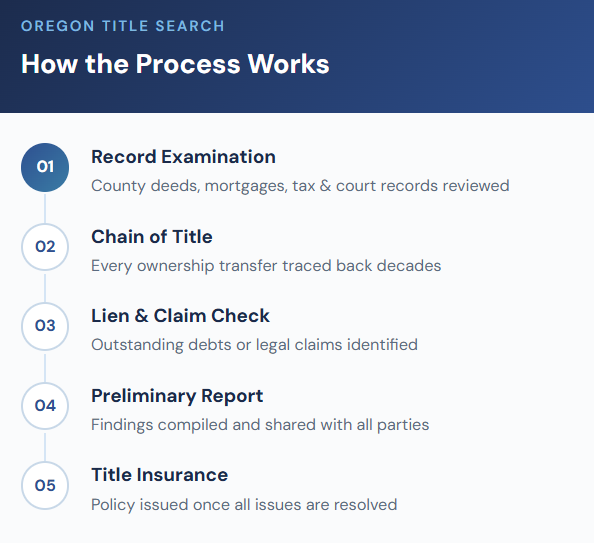
In Oregon, title searches are performed by title companies, escrow officers, or real estate attorneys. These professionals have direct access to county-level public records and the expertise to interpret what those records reveal about a property’s legal status.
The process begins with an examination of public property records filed with the county recorder’s office. This includes recorded deeds, mortgage documents, property tax records, court judgments, and any filings related to liens or encumbrances. Each document is reviewed to build a complete picture of the property’s legal history.
A central part of the title search is verifying the chain of title. This means tracing every recorded transfer of ownership from the current owner back through previous owners, often spanning several decades. Each transfer must be properly documented with a valid deed. If any link in the chain is missing, unclear, or improperly recorded, it raises a red flag that must be resolved before the sale can close.
Ownership history is confirmed by cross-referencing recorded deeds against court records, tax assessments, and lien filings. The title examiner checks that each prior transfer was legally executed, that no forged or fraudulent documents appear in the record, and that all parties in each transaction had the legal authority to buy or sell.
Once the examination is complete, the title company issues a preliminary title report. This document summarizes the current ownership status, identifies any recorded exceptions or encumbrances, and outlines the requirements that must be met before title insurance can be issued. In Oregon, this report is shared with the buyer, seller, and lender as a standard part of the closing process.
What Does a Title Search Look For?
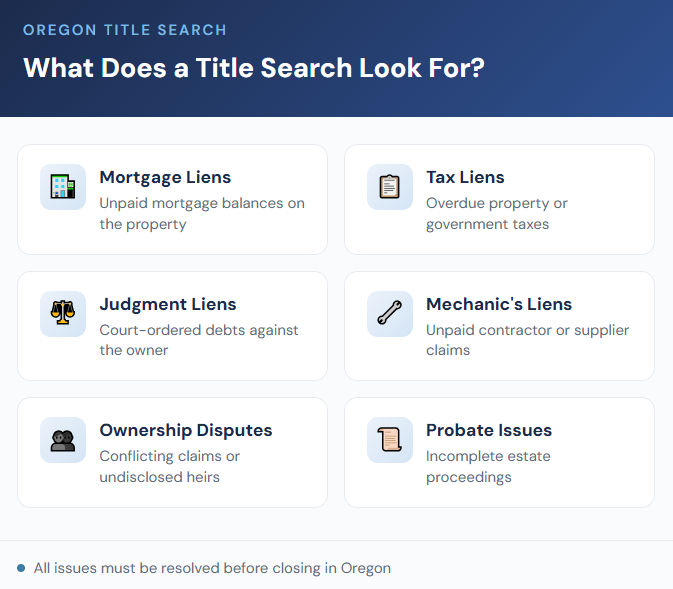
A title search examines multiple categories of public records. Below are the most common issues a title search is designed to identify.
- Mortgage liens: Outstanding mortgage balances that must be paid off before the property can transfer. Learn more about types of liens that affect a home sale.
- Tax liens: Unpaid property taxes or state and federal tax debts recorded against the property. Oregon counties file tax liens that attach directly to the property and must be resolved before closing.
- Judgment liens: Court-ordered debts filed against the property owner. These attach to all real property owned by the debtor in that county. For guidance on resolving these, see how to handle mortgage and judgment liens when selling a house.
- Mechanic’s liens: Claims filed by contractors or suppliers who performed work on the property but were not paid. In Oregon, these must be filed within a specific statutory period.
- Ownership disputes: Conflicting claims to the property, such as undisclosed heirs or errors in prior deeds. These can significantly delay or prevent a sale.
- Easements and restrictions: Recorded rights that allow others to use part of the property (utility easements, shared driveways) or restrict what the owner can do with the land.
- Probate complications: Issues arising from incomplete estate proceedings, especially when a property owner has died and legal authority to sell has not been formally established.
If a title search reveals liens, sellers may need to take steps to resolve them. Resources such as how to remove liens before selling a house, selling a house with liens in Oregon, and legal steps to sell a house with liens can help property owners understand their options.
Why Is a Title Search Important When Selling a House in Oregon?
A title search protects both the buyer and the seller in a real estate transaction. It confirms that the seller has legal authority to transfer ownership and that the buyer will receive a property free of undisclosed claims.
In Oregon, a title search is required before a title insurance policy can be issued. Lenders require title insurance as a condition of financing, and most cash buyers also request it. Without a completed title search, the transaction cannot proceed to closing.
Title searches help prevent delayed closings. When liens or ownership issues are discovered early, the parties involved can negotiate solutions before the closing date. This reduces the risk of last-minute surprises that could cancel the deal.
A clear title also ensures a smooth ownership transfer. Whether a homeowner is working with a real estate agent or considering a direct sale, the title search is a standard part of the closing process. Sellers looking to understand the full process of selling a house in Oregon can find the title search step in nearly every transaction type.
How Title Issues Affect Probate and Inherited Property
Title searches often uncover ownership issues related to estates and inherited property. When a property owner dies, the title does not automatically transfer to heirs. A legal process must establish who has authority to sell or transfer the property.
In Oregon, this process typically involves probate, where a court appoints a personal representative to manage the estate. A title search will reveal whether probate has been completed and whether the current owner has legal standing to sell. For more detail on how this works, see what is probate property and who owns a house during probate.
In some cases, property may be transferred outside of probate through instruments like a living trust or transfer-on-death deed. A title search confirms whether such a transfer was properly recorded. More information is available on whether property can be transferred without probate.
What Happens If a Title Problem Is Found?
Most title problems can be resolved before closing, though some require more time and effort than others. The resolution depends on the type and severity of the issue.
Common resolutions include:
- Lien payoff: Outstanding liens are paid from the seller’s proceeds at closing, or the seller arranges payment beforehand. For negotiation strategies, see how to negotiate lien payoffs when selling a house.
- Judgment settlement: The seller works with the creditor to satisfy or release the judgment lien before the property transfers.
- Probate court clearance: If the title search reveals incomplete probate proceedings, the estate representative may need to obtain court approval before the sale can proceed.
- Quiet title action: In cases where ownership is disputed or unclear, an Oregon court can issue a ruling that establishes clear ownership. This legal process can take several months.
- Negotiation before closing: Buyers and sellers may agree to escrow funds to cover known title issues, allowing the transaction to close while the problem is being resolved.
In Oregon, title companies typically work with the parties and their attorneys to coordinate these resolutions. The preliminary title report serves as the starting point for identifying what needs to be addressed.
Common Title Issues: At a Glance
| Title Issue | What It Means | Typical Resolution |
|---|---|---|
| Mortgage Lien | Unpaid mortgage balance on the property | Paid off at or before closing |
| Tax Lien | Unpaid property or government taxes | Paid from proceeds or settled beforehand |
| Judgment Lien | Court-ordered debt attached to property | Negotiated payoff or release |
| Mechanic’s Lien | Unpaid contractor or supplier claim | Paid or disputed through legal process |
| Ownership Dispute | Conflicting claims to the property | Quiet title action in court |
| Probate Issue | Incomplete estate or heir verification | Court clearance or probate completion |
Bottom Line
A title search is a fundamental step in any Oregon real estate transaction. It verifies that the seller holds legal ownership and that no hidden liens, claims, or encumbrances will affect the transfer.
Both buyers and sellers benefit from a title search. Buyers gain confidence that they are purchasing a property with clear ownership. Sellers avoid surprises that could delay or cancel the closing.
In Oregon, title searches are required before title insurance can be issued and before a lender will approve financing. Whether a sale involves a traditional listing, a direct buyer, or a transfer between family members, the title search is an essential safeguard for all parties involved.
Frequently Asked Questions
Who pays for a title search in Oregon?
In most Oregon transactions, the seller pays for the title search and the owner’s title insurance policy. However, this is negotiable and can vary depending on the terms of the purchase agreement.
How long does a title search take?
Typically, a title search in Oregon takes one to two weeks. Complex ownership histories, unresolved liens, or probate-related issues can extend this timeline.
Can you sell a house without a title search?
Technically, a private sale could close without a title search, but it is not recommended. Lenders require a title search before issuing financing, and most buyers and title insurance companies will not proceed without one.
What is title insurance?
Title insurance is a policy that protects the buyer and lender against financial loss from title defects that were not discovered during the title search. In Oregon, title insurance is issued after the title search is completed and all known issues are resolved.
Does a title search show unpaid taxes?
Yes. A title search includes a review of county property tax records and will reveal any unpaid property taxes or tax liens filed against the property.

Hi, I’m Bob Bash, founder of OR Home Buyers, serving the Oregon community since 2017. We provide full-service real estate solutions, specializing in cash purchases for both residential and commercial properties. I started this business to help our community navigate difficult real estate situations with professionalism, ethics, and compassion.
My goal is simple: to make every client feel relieved and happy when their real estate challenges are resolved. Helping people find solutions and peace of mind is what drives me every day.